
Henry David Thoreau
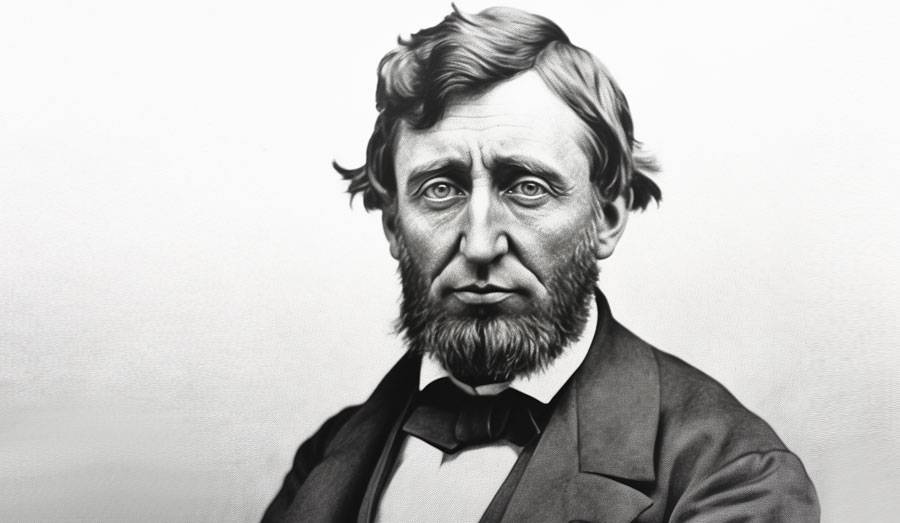
Henry David Thoreau remains one of America’s most enduring literary and philosophical voices. Born David Henry Thoreau on June 12, 1817, given the name David Henry, but would later change it to Henry David as he felt it sounded more like a writer. He died May 6, 1862, also in Concord, Massachusetts. He was 45 years old at the time of his death.
He became a leading figure of the Transcendentalist movement, a circle of writers and thinkers who championed individual conscience, simplicity, and a deeper, more intimate relationship with nature. Though best known for Walden, Life Without Principle, and Civil Disobedience, his influence reaches far beyond those pages, into environmentalism, social reform, and the global discourse on freedom and moral responsibility. He was educated at the Concord Academy and Harvard University.
He was an American essayist, a poet, philosopher, abolitionist, naturalist, tax resister, development critic, surveyor, and historian.
How Emerson Influenced Thoreau
Ralph Waldo Emerson significantly influenced Henry David Thoreau, both personally and intellectually. Emerson, a leading transcendentalist of his time, played a pivotal role in Thoreau’s life, guiding him in his philosophical and literary endeavors. Here are some key aspects of Emerson’s influence on Thoreau:
- Mentorship and Personal Support: Emerson acted as a mentor to Thoreau after they met in 1837. Emerson took a keen interest in Thoreau’s potential, encouraging him to develop his ideas and to write. Emerson even allowed Thoreau to live with his family for a time, providing him with intellectual and moral support and practical assistance, such as access to his library.
- Introduction to Transcendentalism: Emerson introduced Thoreau to the principles of Transcendentalism. This philosophical movement emphasized the inherent goodness of people and nature and the supremacy of individual intuition and the spiritual over the material. Thoreau embraced these ideas, central to his philosophy and writings.
- Nature and Environmentalism: Emerson’s deep appreciation for nature profoundly influenced Thoreau. Emerson’s essay “Nature” (1836) is often considered a foundational work of American environmental thought and deeply impacted Thoreau. The Nature Essay led Thoreau to explore his ideas about nature further, culminating in works such as “Walden,” where he documented his experiment in simple living close to nature.
- Civil Disobedience and Social Reform: Emerson’s essays and lectures on social reform and individualism influenced Thoreau’s thoughts on civil disobedience. Although Thoreau would develop his distinct approach to these issues, Emerson’s emphasis on individual conscience and the moral obligation to resist unjust laws paved the way for Thoreau’s famous essay, “Civil Disobedience.” This work argued for nonviolent resistance to immoral government actions and has inspired numerous social activists since.
- Literary Influence: Beyond philosophy, Emerson influenced Thoreau’s literary style and career. Emerson encouraged Thoreau to write and publish his works, and Thoreau was a regular contributor to “The Dial,” a transcendentalist magazine that Emerson edited. Emerson’s support helped Thoreau gain exposure as a writer and thinker.
- Philosophical Dialogues: Their relationship was characterized by intellectual exchange and debate, helping to refine Thoreau’s thoughts on individuality, democracy, and nature. Despite their occasional disagreements, this discourse contributed significantly to the development of Thoreau’s ideas and writings.
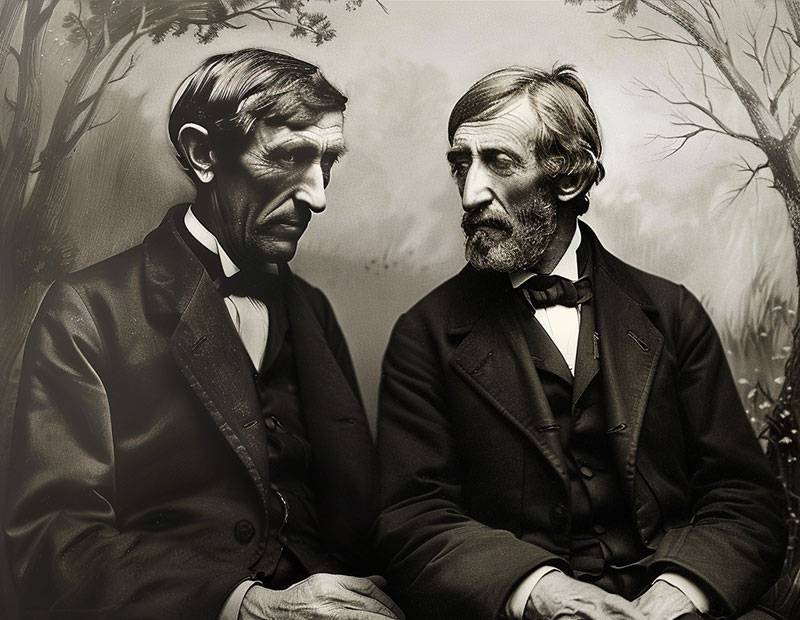
Ralph Waldo Emerson was a crucial figure in Thoreau’s life, providing him with intellectual guidance, personal support, and literary opportunities. Through their friendship and philosophical engagements, Emerson’s influence on Thoreau was profound, shaping his thoughts, writings, and the legacy he left behind.
Thoreau’s relationship with Ralph Waldo Emerson changed the course of his life. Emerson recognized in the younger man a fierce independence of mind and a rare contemplative spirit. Emerson opened his library, introduced him to the Transcendentalist circle, and encouraged his early writing.
The Transcendentalists believed in:
- the primacy of individual conscience
- the divinity of nature
- the necessity of self-reliance
- the courage to resist social conformity
Thoreau absorbed all of these, but he lived them more literally and more radically than anyone else in the group. Where Emerson articulated the philosophy, Thoreau embodied it.
Early Life and Education
Thoreau was born and raised in Concord, Massachusetts, a town that would become both the physical and spiritual landscape of his life. Concord’s woods, ponds, and meadows shaped his imagination early on, as did the intellectual community that gathered around Ralph Waldo Emerson, who would become his mentor, friend, and greatest intellectual influence.
Thoreau attended Concord Academy before enrolling at Harvard College, graduating in 1837. At Harvard, he absorbed classical literature, Eastern philosophy, and the natural sciences—threads he later wove into his own unique worldview. Upon returning to Concord, he and his brother John opened a small and innovative school, notable for its progressive teaching methods and outdoor learning.
The loss of his brother John, who died of tetanus in 1842, marked Thoreau deeply. The grief that followed intensified his inward turn, sharpening his reflections on death, solitude, and the deeper purpose of a human life.
And here are summaries of his two most well-known works, which are currently listed on the site. I think these will greatly help those who want to know more about Thoreau, and I find it interesting is he criticizes people for being more focused on making money than they are focused on personal integrity. It seems nothing has changed in the world!
Civil Disobedience (1849)
In “Civil Disobedience,” Thoreau argues for the importance of individual conscience over the dictates of laws and government policies, especially when those laws and policies are unjust. This essay was a response to his imprisonment for refusing to pay a poll tax, which he considered to support slavery and the Mexican-American War, both of which he opposed.
- Personal Integrity over Compliance: Thoreau emphasizes staying true to one’s moral principles, even when they conflict with the state’s laws.
- Nonviolent Resistance: He advocates for nonviolent resistance to oppose and effect change against unjust government practices.
- Critique of Government: Thoreau is critical of any government that infringes upon the individual’s moral autonomy and argues that sometimes the best government is the one that governs the least.
- Moral Responsibility of Individuals: He believes individuals have a moral responsibility to resist and not participate in injustice, even in a democratic society.
- Influence on Social and Political Movements: This work has profoundly influenced global civil rights and social justice movements, inspiring leaders like Martin Luther King Jr. and Mahatma Gandhi.
Thoreau’s political thought crystallized after he refused to pay a poll tax in protest against slavery and the Mexican-American War. For this act he was briefly jailed, an experience that inspired his seminal essay, “Civil Disobedience.”
In it he argued:
- that unjust laws must be resisted
- that conscience outranks the authority of the state
- that nonviolent resistance is a moral duty
A century later, Thoreau’s words would influence leaders such as Mahatma Gandhi, Martin Luther King Jr., Leo Tolstoy, and the global nonviolent resistance movements that shaped the 20th century.
Few American writers have had such a direct impact on world history.
Life Without Principle (1863)
“Life Without Principle” delves into Thoreau’s critique of his time’s American social and economic life, focusing on how society’s values are misplaced, prioritizing wealth and commerce over integrity and simplicity.
- Critique of Materialism and Economic Pursuits: Thoreau criticizes the societal emphasis on financial success and economic growth at the expense of moral and spiritual well-being.
- The Importance of Individualism: He argues for living according to one’s values rather than societal expectations, advocating for a life that is true to one’s principles and interests.
- Living Deliberately: Similar to his reflections in “Walden,” Thoreau encourages living a simple, deliberate life focused on what truly matters rather than being caught in the pursuit of wealth and possessions.
- Meaningful Work: He emphasizes the importance of engaging in work that is fulfilling on a personal and ethical level rather than just for financial gain.
- Reflection on Personal Values: Thoreau calls for introspection and the reevaluation of one’s life and choices based on personal values and principles rather than external measures of success.
Both works embody Thoreau’s commitment to individualism, personal integrity, and social justice, challenging readers to reconsider their values, the structure of society, and their role within it.
Walden: A Life Examined
In 1845, Thoreau built a small cabin on land Emerson owned at Walden Pond, beginning what would become his most famous experiment in living. For two years he lived simply—planting beans, observing the changing seasons, writing in his journal, and paring life down to its essentials.
Walden (1854) is not just a memoir of that experience. It is a meditation on:
- the meaning of simplicity
- the value of solitude
- the illusions of material success
- the spiritual nourishment that comes from nature
With clarity and gentle insistence, Thoreau challenged readers to examine their own lives:
“The mass of men lead lives of quiet desperation.”
His message remains relevant precisely because the human tendency toward distraction, accumulation, and busyness has only intensified. Walden is still one of the most important American works on personal independence and mindful living.
Nature, Observation, and the Birth of Environmentalism
Thoreau was not only a philosopher—he was a meticulous naturalist. His journals contain years of detailed observations on plants, birds, weather patterns, and seasonal changes around Concord. Scholars today regard these journals as some of the earliest works of modern environmental science.
His core beliefs included:
- that nature is inherently sacred
- that wildness is essential to human health
- that humans must live in harmony with the natural world
- that industrial expansion threatens ecological balance
Thoreau’s writings—especially Walden and The Maine Woods—position him as a founding figure of environmentalism. Modern conservationists still echo his insistence that natural spaces must be protected not merely for their beauty, but for the human spirit.
Major Writings and Intellectual Legacy
Thoreau’s body of work includes essays, books, lectures, and a journal spanning over two million words. His key contributions include:
Walden (1854)
A masterpiece of American literature and philosophy, exploring the meaning of deliberate, thoughtful living.
Civil Disobedience (1849)
A groundbreaking argument for moral resistance to unjust state power.
The Maine Woods
A vivid account of wilderness travel and Indigenous guides, blending natural observation with philosophical inquiry.
A Week on the Concord and Merrimack Rivers
A reflective expedition narrative honoring his brother John and exploring themes of memory, mortality, and the rhythms of nature.
Taken together, his writings continue to shape discussions on ecology, ethics, self-reliance, personal freedom, and the obligations of citizenship.
Impact on American Literature
Thoreau’s influence on American literature is vast. His prose—spare, direct, and rooted in lived experience—helped shape the distinctively American voice later reflected in:
- Robert Frost
- Ernest Hemingway
- Walt Whitman
- Emily Dickinson
- Mark Twain
His themes of solitude, nature, and independence reverberate through the modern environmental movement and the counterculture of the 1960s. His insistence on listening to one’s inner voice remains a cornerstone of American identity.
Contemporary Relevance
More than 160 years after his death, Thoreau’s ideas feel urgently modern.
Environmentalism
His call to preserve wild places has become a global movement.
Social justice & political resistance
Nonviolent civil disobedience remains one of the central tools of advocacy around the world.
Minimalism and simplicity
As digital life grows busier, Thoreau’s message of deliberate living speaks to a new generation seeking meaning over materialism.
Spiritual and personal growth
Thoreau’s emphasis on introspection, mindfulness, and inner integrity resonates with contemporary seekers across all backgrounds.
His enduring relevance is a testament to a life lived with conviction.
Quotes associated with Thoreau:
“If you have built castles in the air, your work need not be lost; that is where they should be. Now put the foundations under them.
“Go confidently in the direction of your dreams. Live the life you have imagined.”
“Our life is frittered away by detail…simplify, simplify.”
Conclusion
Henry David Thoreau was more than a writer; he was a thinker who lived his philosophy with uncommon courage. His life at Walden Pond, his stand for conscience in “Civil Disobedience,” and his devotion to the natural world form a legacy that continues to inspire readers, activists, and seekers today.
In an age defined by noise, Thoreau invites us to slow down.
In a world of conformity, he asks us to think for ourselves.
In a time of environmental crisis, he reminds us of our bond with nature.
And in a society hungry for meaning, he offers a path toward a richer, more deliberate life.
Few voices from the 19th century speak so clearly to the 21st.
And few lives so fully embody the pursuit of integrity, freedom, and truth.